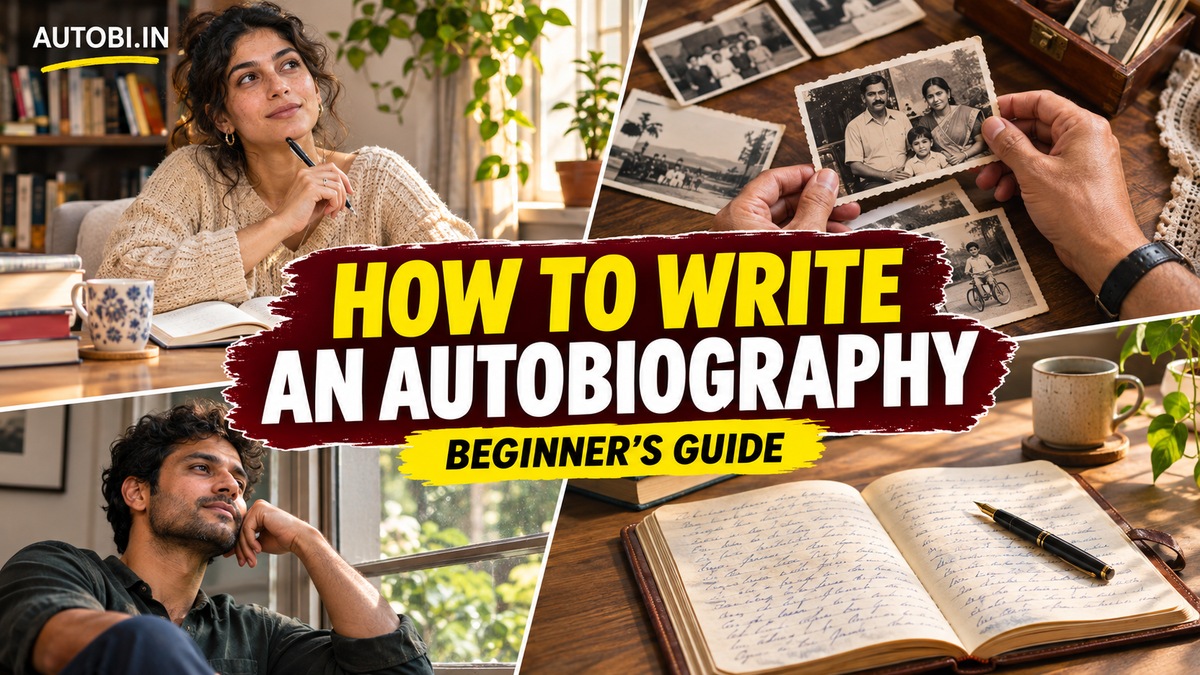
To write an autobiography, decide who will read it, list the events that shaped you, arrange those memories into chapters, and draft one specific scene at a time. Then check facts and revise the story so readers understand both what happened and why it mattered.
You do not need a dramatic life or a publishing contract to begin. A short account for your children, a school assignment and a full life-story book can all start with the same thing: one memory you can describe honestly.
1. Choose your reader and your purpose
Write one sentence before you plan chapters: “I am writing this for ___ so they can understand ___.” A family book may explain traditions and relationships. A student autobiography may show how interests developed. A public book needs enough context for readers who have never met you.
Choose a manageable first version. Six short chapters are easier to finish than an undefined promise to document everything. Your first draft is a starting point, not a final limit.
2. Build a simple life timeline
List ten to fifteen turning points, including ordinary changes: moving house, meeting a friend, learning a skill, taking responsibility or changing your mind. For each event, note your approximate age, the place, the people involved and what changed afterward.
Use photographs, calendars, school records and letters to check dates. Mark uncertain details as uncertain. A vivid memory is not always an accurate record, so separate what you remember from what someone later told you.
3. Find the thread connecting your memories
A timeline tells you what happened; a thread tells readers why those events belong together. Your thread might be finding a home, learning independence, building a career or caring for family. You can cover several themes, but give each chapter a clear purpose.
Ask of every proposed chapter: “What does the reader understand about me after this?” If two chapters answer exactly the same question, consider combining them.
4. Turn your timeline into chapters
Try this flexible sequence: roots and family; childhood; school and friendships; early independence; a turning point; work and relationships; lessons learned; life today. Use our autobiography format and outline to adapt the structure to a short essay or a longer book.
Chronological order is usually easiest for a first project. You can open with a later moment and return to childhood, but make changes of time clear so readers do not have to reconstruct the sequence.
5. Write a scene before you write a summary
Choose a moment with a setting, an action and a consequence. Describe what you actually remember: the place, a gesture, an object or a sound. Then explain what you thought at the time and what you understand now.
Original illustrative opening: “I kept the house key in the smallest pocket of my schoolbag. On the first afternoon I walked home alone, I checked that pocket at every crossing. The journey took fifteen minutes, but it was the first time responsibility felt like something I could hold.”
The key is concrete; the reflection gives it meaning. Avoid inventing exact dialogue to make a scene feel complete. Paraphrase conversations when the wording is uncertain.
6. Keep writing when memory feels incomplete
Begin with a prompt rather than a perfect first sentence. What did your childhood kitchen look like? Who taught you something you still use? Which decision changed your daily routine? Our 50 autobiography writing prompts can help you choose a starting point.
Write a rough paragraph or speak a memory aloud and transcribe your own account. Leave a note such as “[check year]” when research would interrupt the draft.
7. Revise in three separate passes
- Structure: Does every chapter add something? Are time changes understandable?
- Truth and context: Check names, dates and quotations. Distinguish memory from documented fact.
- Language: Remove repetition, explain unfamiliar references and read sentences aloud.
Consider the privacy of people in your story, particularly children. Omit unnecessary addresses, account details and private information. Ask permission before using someone else’s photographs or private correspondence.
Common questions
Must an autobiography begin with my birth?
No. You can begin with a meaningful scene, then explain earlier events. Choose the opening that helps your reader understand the story.
How long should it be?
Follow the assignment if one exists. For a personal project, choose a length you can finish and expand later. There is no universal required word count.
Can I focus on just one period?
Yes. A focused account is often described as a memoir. Compare memoir vs autobiography before choosing your scope.
Start with one chapter today
Pick one turning point, write for fifteen minutes and stop after explaining why it matters. Use the Autobiography Maker to organize your draft, and keep a separate backup of your work.